

Master the rent roll: Understand its role in commercial real estate valuation, how to analyze tenant reliability, and why accurate data is the backbone of your next deal.
Commercial real estate investors lose money when they ignore property records. A single hidden lease clause can erase thousands of dollars in net operating income. Smart buyers inspect every lease agreement before they put capital on the line. The rent roll gives you the exact blueprint of a property's cash flow. It shows who pays rent, how much they pay, and when their leases end. This single document determines whether a deal makes money or bleeds cash.
The Silent Engine of CRE Valuation
Every commercial property relies on stable cash flow. The rent roll drives that cash flow. Appraisers, lenders, and buyers inspect this document to verify real income. You cannot calculate true property value without checking actual tenant payments. According to a 2023 survey by NAIOP, lease audit errors account for over 5% of unexpected net operating income loss in commercial acquisitions. Finding these errors early protects your investment returns.
Key Takeaway: A rent roll serves as the financial heartbeat of a commercial property. It proves whether reported income matches real bank deposits.
What Is a Rent Roll?
What is a rent roll in commercial real estate? A rent roll is a detailed register that provides a snapshot of all tenant leases within a commercial property at a specific point in time. It lists critical tenant data, rental rates, lease start and end dates, security deposits, and payment histories.
Property managers update this master document monthly. Buyers use it during due diligence to confirm lease terms and payment compliance. Lenders require it before they approve commercial mortgages. Without a detailed rent roll, you cannot evaluate property performance or forecast future cash flow accurately.
Why Does the Rent Roll Matter?
How does a rent roll impact property valuation? A rent roll impacts property valuation because it provides the raw revenue figures used to calculate Net Operating Income (NOI) and Capitalization Rates. Capitalization rates directly tie property value to verifiable tenant income.
Risk Assessment
A rent roll highlights lease rollover risk. If 40% of your tenants leave in the same year, your cash flow drops sharply. You must spot these lease concentrations early to protect your debt coverage. Identifying lease structures helps you prepare for future tenant turnover and re-leasing costs.
NOI Calculation and Market Positioning
Net Operating Income relies on gross income minus operating expenses. The rent roll gives you the exact gross income figure. Compare your tenant rents to local market rates. You will quickly see if the property offers upside potential through rent bumps or carries overmarket risks that could drop income upon renewal.
Key Components: How to Read a Rent Roll
Reading a rent roll requires systematic analysis. You must check specific data points across every row to ensure accuracy before making an offer.
Core Data Points
Every rent roll must contain fundamental tenant metrics. Skimming these details often leads to costly mistakes during financial underwriting.
Tenant Name and Unit Identification
Match tenant names to legal corporate entities. Verify that unit numbers match the physical building layout and suite directory.
Lease Terms and Square Footage
Check square footage numbers against physical floor plans. Verify start dates, expiration dates, renewal options, and escalation clauses for every single space.
Security Deposits and Financial Obligations
Confirm collected security deposits against landlord bank records. Ensure that the seller transfers these tenant funds to your account at closing.
Common Red Flags to Watch For
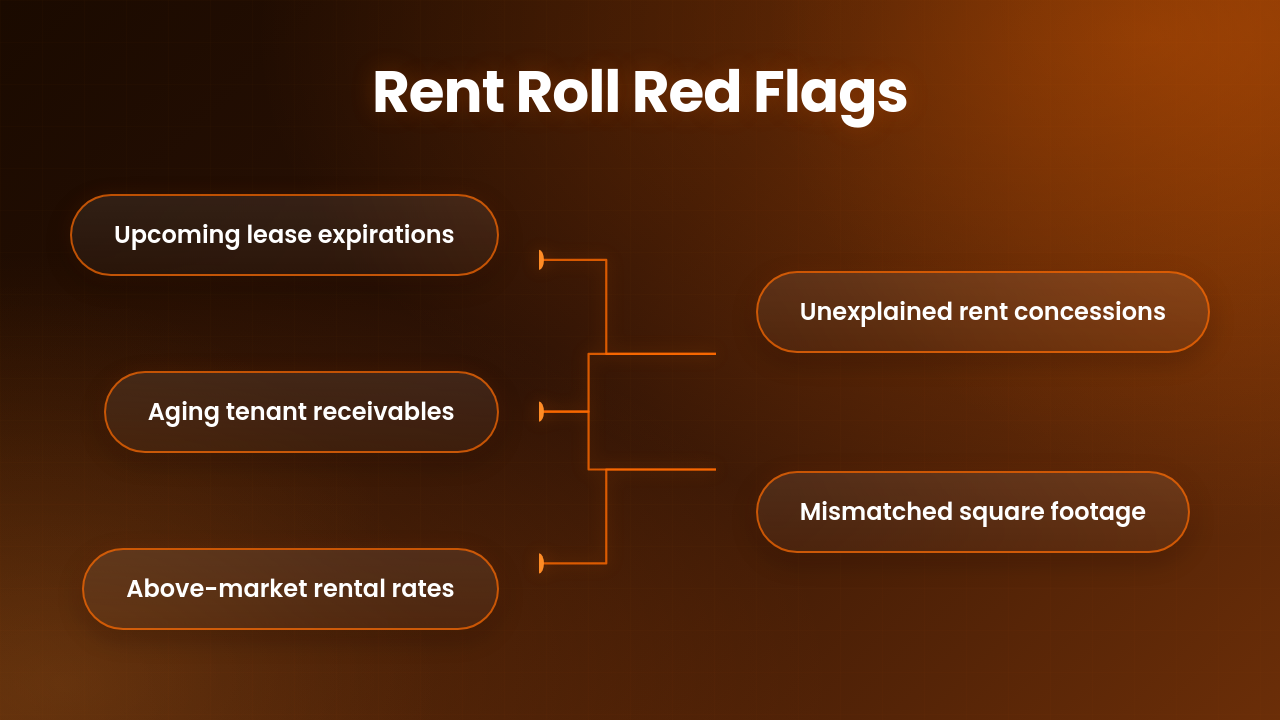
Sellers sometimes polish financial reports to hide structural issues. You must look past surface numbers to spot hidden financial risks on a rent roll.
- High concentration of upcoming lease expirations: Multiple leases ending simultaneously increase immediate vacancy risk and expensive tenant improvement costs.
- Growing aging receivables: Tenants who owe 60 or 90 days of back rent signal operational struggles and potential future defaults.
- Above-market rental rates: Overpriced leases might collapse when current terms end, forcing rental income down to market levels.
- Unexplained concessions: Free rent, temporary discounts, or large tenant improvement allowances reduce your true effective yield.
- Mismatched square footage: Incorrect space measurements distort rent per square foot metrics and distort your valuation models.
Rent Roll Template & Best Practices
Organized data leads to faster deal analysis. Standardize your rent roll formats to accelerate financial modeling across your acquisition pipeline.
Keep your rent rolls updated monthly. Store documents in structured databases rather than loose spreadsheet files. Always verify rent roll numbers against monthly bank statements and signed estoppel certificates during formal due diligence.
Rent Roll Example: A Quick Walkthrough
Consider a small multi-tenant retail center with three active suites. The table below illustrates how a clean rent roll presents property data for quick review.
| Unit / Suite | Tenant Name | Square Feet | Monthly Rent | Lease End Date | Security Deposit |
|---|---|---|---|---|---|
| Suite 101 | Apex Coffee LLC | 1,500 | $4,500 | 10/31/2027 | $4,500 |
| Suite 102 | Metro Cleaners | 1,200 | $3,200 | 05/31/2025 | $3,200 |
| Suite 103 | Vacant Space | 2,000 | $0 | N/A | $0 |
This snapshot shows immediate details. Suite 103 yields zero income, while Suite 102 faces renewal next year. You can calculate physical vacancy at 42.5% based on total building square footage of 4,700 square feet. This insight tells you immediately that lease-up strategy will drive future returns.
The Manual Data Trap vs. Digital Efficiency
Why is manual rent roll data entry risky for CRE investors? Manual rent roll data entry causes costly human errors, slow underwriting times, and missed red flags in complex commercial deals. Typos in monthly rent amounts or misread lease dates warp your financial modeling instantly.
Analyst teams spend hours rekeying PDF numbers into Excel spreadsheets. This manual task slows deal velocity and delays offer submissions. Modern dealmakers swap spreadsheet copy-pasting for automated parsing tools to audit properties faster.
How PropQwik Simplifies Your CRE Workflow
PropQwik streamlines data processing for commercial real estate professionals. You can digitize messy PDF rent rolls instantly and focus your effort on analyzing deal terms.
- Instant Data Extraction: Upload rent rolls in PDF or image format to extract structured tenant data within seconds.
- Automated Formatting: Convert raw tables directly into standardized Excel models without retyping text manually.
- Error Detection: Spot layout mismatches and mathematical inconsistencies before you finalize property valuations.


Conclusion: Turn Data into Deals
A rent roll holds the truth behind every commercial real estate opportunity. Understanding its contents protects your capital and helps you price assets accurately. Modern commercial real estate relies on swift, precise data analysis. Clean data accelerates your underwriting and sharpens your competitive edge in every deal. Start auditing your rent rolls with software precision today to win better deals faster.
Rent rolls disclose actual revenue, tenant reliability, and lease expiration risks. Investors, lenders, and appraisers use this master ledger to evaluate Net Operating Income and property value. Automating rent roll analysis prevents manual data entry mistakes and speeds up deal execution.
Frequently Asked Questions
Q1. What is the primary purpose of a rent roll?
A: A rent roll provides a complete financial overview of property income. It allows buyers, lenders, and property managers to audit tenant performance, lease terms, and revenue stability.
Q2. How often should a property manager update a rent roll?
A: Property managers should update the rent roll monthly. Frequent updates track rent payments, late fees, lease renewals, and tenant vacancies in real time.
Q3. What is the difference between a rent roll and an income statement?
A: A rent roll details individual tenant leases, space measurements, and rental rates. An income statement summarizes total property revenues and expenses over a given accounting period.
Q4. Why do lenders require a rent roll during loan underwriting?
A: Lenders examine rent rolls to verify cash flow stability and calculate debt service coverage ratios. Verified lease income proves that the property can service its monthly debt payments.
Q5. What is tenant concentration risk on a rent roll?
A: Tenant concentration risk occurs when a single tenant or industry occupies a large portion of space or generates most of the property's income. If that tenant defaults, property cash flow drops significantly.
Q6. How do you verify if rent roll numbers are accurate?
A: Verify rent rolls by comparing listed rents against signed tenant lease agreements, bank deposit statements, and estoppel certificates during your due diligence process.
Q7. What are estoppel certificates and why do they matter alongside rent rolls?
A: Estoppel certificates are legally binding documents signed by tenants to confirm current rent amounts, lease end dates, and security deposits. They confirm that the seller's rent roll matches the tenant's actual lease understanding.