

Stop wasting hours preparing CRE investment committee decks. Discover a streamlined workflow to convert raw listing data into a powerful, decision-driving presentation, complete with crucial slides like the executive summary and financial highlights. Learn how to impress your committee and close more deals.
Master Your CRE Investment Committee Deck: From Listing Data to Approval
Introduction: Your Pitch, Your Precision
In the high-stakes world of commercial real estate, securing investment approval hinges on one critical document: your investment committee deck. It is not just a collection of slides; it is your deal’s narrative, its financial pulse, and its strategic roadmap. Compiling this deck traditionally meant countless hours of manual data extraction from listing websites, then copy-pasting, formatting, and facing inevitable errors. This workflow drains time and energy better spent on analysis and negotiation.
This comprehensive guide will walk you through preparing a powerful CRE investment committee deck from listing data. We will cover essential components like the ideal slide order, the impactful executive summary slide, and the crucial financial highlights. We will also reveal how PropQwik simplifies this laborious process, making it much more efficient.
Why Your Investment Committee Deck is Your Golden Ticket
Your investment committee deck plays a central role in every real estate deal. It synthesizes all your hard work and research into one compelling package.
- Decision-Making Hub: The deck acts as the cornerstone for critical investment decisions. It presents a clear summary of your due diligence findings.
- Professionalism & Trust: A well-structured, data-backed presentation builds confidence. It shows your expertise and attention to detail.
- Securing Capital: This document is your primary tool. It helps convince investors, partners, or internal committees to greenlight your next venture. A strong deck helps you win the necessary funding.
The Traditional Headache: Manual Data to Monumental Task
Many professionals face a common struggle when creating these vital presentations. The manual process can be incredibly frustrating.
- The Grind: Picture yourself toggling between LoopNet, Crexi, or CoStar. You endlessly copy addresses, square footage, cap rates, lease rates, and broker details. Next, you meticulously download images, reformat tables, and double-check every single data point. This repetitive work takes a toll.
- Time Sink & Error Prone: This method is not just inefficient; it is a breeding ground for inaccuracies. It wastes a massive amount of valuable analytical time. How many deals have been slowed, or even lost, because of this manual maze? This old way slows down progress and increases the risk of mistakes.
Deconstructing the Ideal CRE Investment Committee Deck: Slide by Slide
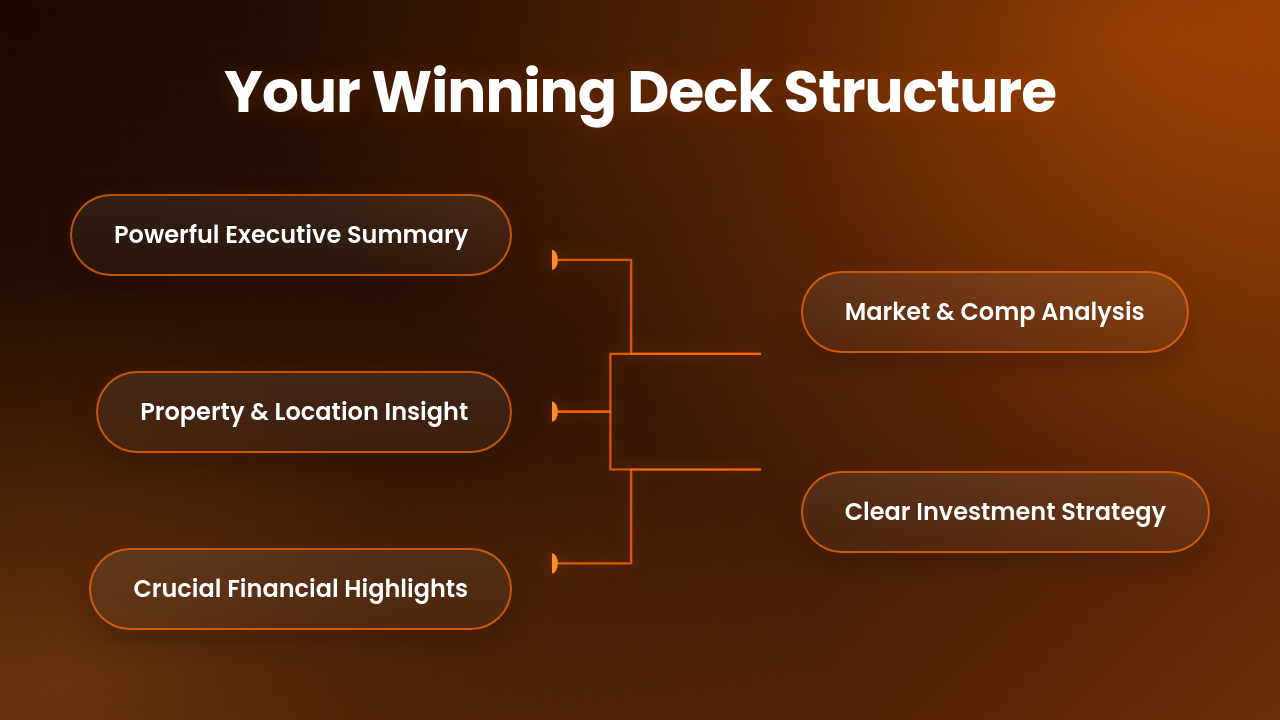
Crafting a persuasive deck requires a logical flow and impactful content. This section details the optimal slide order and what each segment should convey. Following this structure ensures you present information clearly and compellingly.
I. The Ultimate Executive Summary Slide (The Deal-Closer)
This slide is your elevator pitch in visual form – concise, compelling, and immediately informative. It is the most critical part of your investment committee deck from listing data. It needs to grab attention and summarize the entire opportunity.
Key Elements for Your Executive Summary:
- Deal Thesis: A clear, one-sentence statement outlining the core opportunity. What is the main reason for this investment?
- Investment Highlights: Use 3-5 bullet points. These should summarize the property's unique selling points and its value proposition.
- Key Financials: Provide a quick snapshot of projected returns. This includes metrics like Pro Forma Cap Rate, Cash-on-Cash, and IRR. These numbers give a quick financial overview.
- The Ask: Clearly state the capital required and the proposed investment structure. What do you need from the committee?
II. Property Overview & Location Analysis
This section sets the stage by introducing the property itself and its surroundings. Visuals are key here.
Essential Property Details:
- Basic Information: Include the address, property type, size (square feet/acres), year built, and current occupancy rate.
- Visuals: Use high-quality photos. Listing data often provides good images, but consider drone shots if available. Include clear maps highlighting key amenities, transportation routes, and local landmarks.
- Market Context: Provide a brief overview of the submarket. Discuss demographic trends and key economic drivers. This helps show the property's place in the larger market.
III. The Must-Have Financial Highlights (The Numbers that Talk)
The numbers tell the real story. This section dives into the financial performance of the property. All figures should be derived and calculated from listing data, combined with your analysis.
Core Financial Metrics to Include:
- Current & Pro Forma Cap Rate: Explain your assumptions for these rates. Show the current state and projected future performance.
- Cash-on-Cash Return: Illustrate the immediate profitability of the investment. How much cash will be generated relative to the equity invested?
- Internal Rate of Return (IRR): Project the long-term performance and overall profitability.
- Leveraged vs. Unleveraged Returns: Provide a full picture by showing returns with and without debt financing. This helps compare different financing scenarios.
Revenue & Expense Pro Forma:
- Present a concise 5-year projection. Base this on market data and conservative assumptions.
Sensitivity Analysis:
- Demonstrate how returns shift with varying assumptions. For example, show changes based on vacancy rates, rent growth, or exit cap rate. This highlights potential risks and rewards.
IV. Market Analysis & Comparables
Understanding the market is crucial for justifying your investment. This section presents supporting data and comparisons.
What to Include in Your Market Analysis:
- Market Trends: Show relevant data points. This includes vacancy rates, rent growth, absorption rates, and new supply coming to the market.
- Comparable Analysis: Present 3-5 recently sold or leased comparable properties. You can extract these from listings. Use them to justify your valuation and rental rate assumptions. Show why your property stands out or aligns with market value.
What questions do people ask about market analysis?
- How do I find good comparables? You can find good comparables by searching major listing platforms like LoopNet, Crexi, or CoStar for properties similar in size, type, age, and location that have recently sold or leased. PropQwik can help extract this data quickly.
- What if I can't find perfect comps? Focus on properties that are as close as possible and then explain the adjustments needed for differences in features, condition, or location.
V. Investment Thesis & Strategy
This section explains the "why" and "how" of your investment. It clarifies your approach to the property.
Key Components of Your Strategy:
- Why This Property? Articulate the specific rationale for this investment. What makes it unique or attractive?
- Value-Add Opportunities: Clearly outline your plans. These might include renovation strategies, lease-up initiatives, or operational efficiencies you plan to implement.
- Exit Strategy: How do you plan to monetize the investment? For example, will you sell it after improvements, refinance it, or hold it for long-term income?
VI. Risk Assessment & Mitigation
Every investment has risks. This section shows you have thought through potential problems and have plans to address them. This builds trust with the committee.
Addressing Risks:
- Identify Risks: What could potentially go wrong? Think about market downturns, unexpected repairs, tenant defaults, or changes in interest rates.
- Mitigation Strategies: How will you address these potential challenges? Outline specific plans or contingencies for each identified risk.
VII. Team & Experience (Optional, but Impactful)
Adding this section can boost confidence, especially for external investors.
- Team Bios: Include brief bios of key team members. Highlight their relevant experience and track record in real estate. This helps build credibility and shows you have the right people for the job.
VIII. Conclusion & Call to Action
- Recap: Briefly summarize the investment opportunity and its strengths. Reiterate the key benefits and why it is a good deal.
- Clear Request: Reiterate your ask to the committee. Clearly outline the next steps for approval or discussion.
PropQwik: Simplifying Your Deck Creation
What if you could skip the tedious manual work and generate a professional investment committee deck from listing data in seconds? PropQwik offers a solution that makes this possible. It streamlines the entire process, saving valuable time.
- Quick Extraction: Our Chrome and Edge extension extracts publicly visible property data. This includes addresses, prices, cap rates, lease rates, broker contacts, and even listing images. It works directly from major CRE listing websites like LoopNet (with Crexi and CoStar coming soon).
- Instant Presentation: PropQwik does more than just extract data. It automatically structures the information. Then, it generates a professional PowerPoint presentation using Gamma AI. This presentation includes all the slide templates you need, pre-filled with your data.
- Accuracy & Time-Saving: Say goodbye to copy-paste errors and hours lost. You get accurate data, perfectly organized, ready for your executive summary slide and financial highlights. This saves you invaluable time for analysis.
- Smooth Integration: Our Connectivity add-on helps you further. It automatically syncs extracted properties to Google Sheets. It also saves generated PowerPoints directly to Google Drive. This makes your workflow much smoother and more connected.
Your Workflow, Streamlined: Preparing Your Deck with PropQwik
Imagine this efficient process for creating your next investment committee deck. This approach changes how you prepare and present deals.
- Spot a Listing: Browse your favorite CRE listing portal, just as you normally would.
- Quick Capture: Click the PropQwik extension icon. Instantly, all property details, including images, are extracted and structured into a usable format.
- Review & Refine: Add your private notes, mark your favorite properties, and make any quick edits directly within PropQwik.
- Generate Deck: With another click, PropQwik creates a branded, professional PowerPoint deck. It pre-populates all the essential slides – including your executive summary slide and detailed financial highlights. It uses the extracted data and your chosen template.
- Focus on Strategy: Now, instead of spending time on data entry, you are fine-tuning your narrative. You add custom analysis and perfect your pitch. This frees you to focus on the strategic elements of your deal.


Beyond the Data: Polishing Your Presentation for Impact
Even with perfect data, how you present it truly matters. A polished presentation leaves a lasting positive impression.
- Visually Appealing: Use clean layouts, high-quality images, and consistent branding. Make sure your slides look professional and easy to read.
- Concise: Each slide should convey one core idea clearly. Avoid overloading slides with too much information. Get straight to the point.
- Story-Driven: Weave a compelling narrative throughout your deck. Guide your audience through the investment opportunity, building a clear and convincing case.
Conclusion: Close Deals, Faster
Preparing a compelling CRE investment committee deck from listing data used to be a major undertaking. However, with the right structure and the right tools, you can transform hours of tedious work into minutes of strategic preparation.
By focusing on a clear slide order, perfecting your executive summary slide, and meticulously detailing your financial highlights, you are doing more than just presenting data. You are selling a vision and a clear path to success. PropQwik helps you achieve this, giving you a competitive edge to secure approvals and close more deals. Ready to save time and move forward with your investments? Try PropQwik's 7-day free trial today!
Frequently Asked Questions (FAQ)
1. What is the most important slide in a CRE investment committee deck?
The most important slide is often considered the Executive Summary Slide. It provides a quick, high-level overview of the entire opportunity, the key financials, and the ask. If committee members only have a few minutes, this slide should convey the essence of the deal.
2. How long should an investment committee deck be?
While there's no strict rule, most effective investment committee decks are between 15-25 slides. The goal is to be comprehensive without being overwhelming. Focus on conveying necessary information clearly and concisely, rather than adding filler.
3. What are "financial highlights" in an investment deck?
Financial highlights refer to the core financial metrics that show the profitability and performance of a commercial real estate investment. These typically include the Current and Pro Forma Cap Rate, Cash-on-Cash Return, Internal Rate of Return (IRR), and Leveraged vs. Unleveraged Returns. They are crucial for demonstrating the investment's financial viability.
4. Can I really create an investment deck from just listing data?
Yes, you can initiate the creation of an investment committee deck from listing data. Tools like PropQwik extract essential property details, pricing, financials (like implied cap rates), and images directly from listing sites. This forms a strong foundation, which you then enhance with your deeper market analysis, underwriting assumptions, and strategic insights.
5. How do I make my investment deck stand out?
To make your investment committee deck stand out, focus on clarity, visual appeal, and a compelling narrative. Use high-quality visuals, ensure data is accurate and well-supported, and articulate a clear investment thesis. Show how you understand and plan to mitigate risks. A well-prepared presentation, supported by a tool like PropQwik for initial data gathering, makes a big difference.
6. What is E-E-A-T and why is it important for my investment deck?
E-E-A-T stands for Experience, Expertise, Authoritativeness, and Trustworthiness. In an investment deck, it means showing your team's relevant experience and track record (Expertise & Experience). It means backing up your claims with solid data and analysis (Authoritativeness). And it means being transparent about risks and assumptions (Trustworthiness). Injecting E-E-A-T builds confidence with investors.